The short answer
You don't have to.
It's fine not to stay. You really don't have to.
— Akiko, forty years in Matsumoto
That is an unusual thing for someone in the local tourism business to say, and it is the reason the rest of this article is worth reading. There is a specific case for staying overnight in Matsumoto. It is a good case. But it applies to some people and not others, and nobody is served by pretending otherwise.
One thing to be clear about first, because it changes the answer completely. This article is about the city itself. If Matsumoto is your base for Kamikōchi or anywhere else in the mountains, you will need to stay the night — the buses go early and you will not do it as a day trip from anywhere further away. The question below is only whether the town on its own is worth an extra night.
What there is to do after dark
Two things, genuinely worth knowing about.
Matsumoto is a bar town
This came up unprompted and surprised us. Matsumoto has a reputation — search in Japanese for "bar town" and the city comes up — built on proper old-fashioned cocktail bars rather than anything trendy.
I want people to go to the bars. I'm not sure why we became a bar town, but we did.
MAIN BAR COAT laid the groundwork for it. The owner trained in Sapporo — it's a proper authentic bar.
— Akiko
If you go in summer, she has one specific request:
Drink the fruit cocktails. They use local fruit.
— Akiko
Nagano is serious fruit country, and a good bartender working with fruit picked nearby that week is a different proposition from the same drink in a city.
The castle is lit up, and it's free
Matsumoto Castle is illuminated at night, and there is projection mapping on it at certain times of year — at no cost. You will have seen the castle in daylight already; it is a different building in the dark, and standing in front of it costs nothing.
And now the part other articles leave out
We asked what else there is to do at night. The answer was short.
There aren't many places to go out to, really.
— Akiko
So: a bar, and a floodlit castle. That is the honest inventory. If your idea of an evening is a district full of options to wander between, Matsumoto has fewer of them than you are probably picturing, and you should plan accordingly rather than discover it at nine at night. It is also the reason our own walks run in the late afternoon rather than after dinner — that is when there is actually something to show you.
Is it safe to walk around at night?
Since this is the question people actually search for, here is the exchange in full.
Is it alright for a foreign visitor to walk alone at night?
Completely fine.
— Akiko
Anything to watch out for?
No.
— Akiko
We tried to draw out something more nuanced and there wasn't anything. It is a small, quiet, provincial city and walking back to your hotel at eleven at night is unremarkable.
The actual reason to stay is the morning
Here is where the case for an overnight stay is genuinely strong, and it has nothing to do with the evening at all.
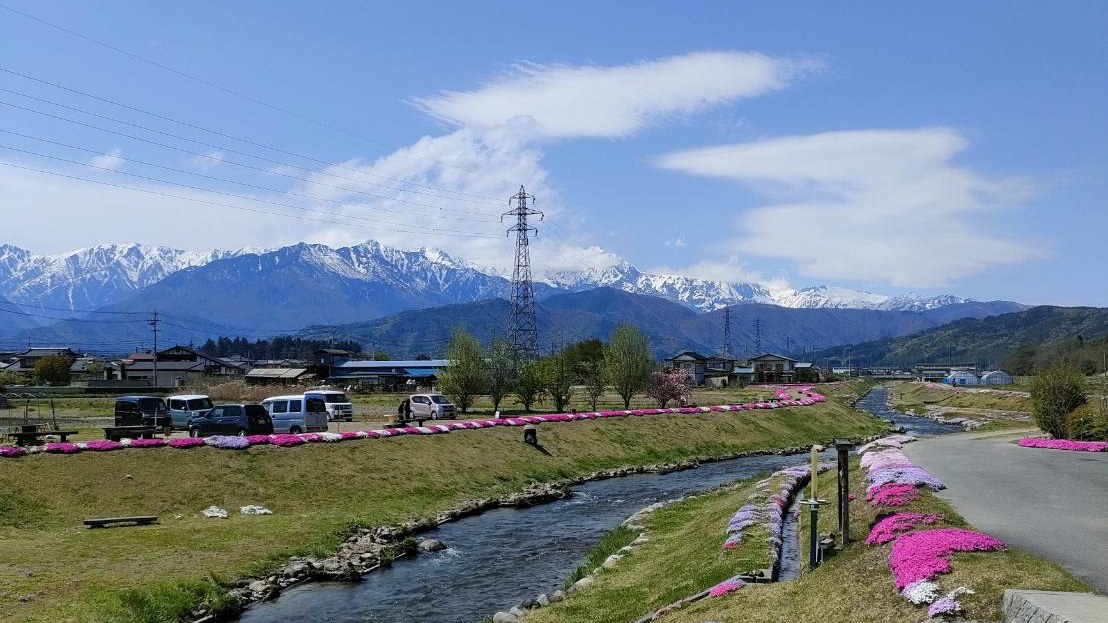
The reason to stay is that you should see the mountains in the early morning.
They're beautiful. You can see all the way to the Alps.
— Akiko
Matsumoto sits in a basin with the Northern Alps on one side. On a clear day the whole range is visible from the middle of an ordinary residential street — you do not need to be up at dawn to see it at all. What the early morning gives you is the range at its best, before the light flattens out and haze settles on the far peaks.
Winter especially. I love it. That sharp, clean feeling in the air.
— Akiko
The other thing you get at that hour is the town doing nothing in particular. What are the locals up to at six in the morning? Walking. That's it. They're out for a walk — which, if you have read anything else on this site, you will recognise as roughly our entire business model.
This is the whole argument in one line: you are not staying overnight for the night. You are staying overnight for the following morning. Not because the mountains are only visible then — but because that is when they look their best, and when the town around them is empty. If that doesn't appeal, the day trip is genuinely the right call.
The other thing an overnight buys you: the bath
This one rarely makes it into the argument, and it should.
Asama Onsen sits on the northeastern edge of Matsumoto — about fifteen minutes by car from Matsumoto Station. These are not resort spas. They are the day-use baths that local people actually use, and they cost somewhere between ¥600 and ¥800.
The catch is timing. The local rhythm puts people in the water between three and five in the afternoon: bathe, go home, eat dinner with a drink, sleep. If you are catching a train back to Tokyo that evening, that window is exactly when you are packing up and heading for the station. Staying the night is what makes the bath available to you at all — and at the hour when it is full of the people who live here rather than other visitors.
If you're going to do it, it's worth knowing the etiquette first — we wrote a whole piece on what a local actually does in an onsen, including the small unwritten rules that trip people up.
Where should you stay?
We came in expecting a neighbourhood-by-neighbourhood breakdown. There isn't one, and that's useful in itself.
Matsumoto isn't big enough to have areas. Anywhere is fine.
— Akiko
The centre is compact enough to walk across, so proximity to a particular street is not worth optimising for. As for a traditional inn versus a hotel:
Whichever you prefer, honestly.
— Akiko
Book whatever suits your budget and your tolerance for shared bathrooms, and spend the saved decision-making effort on getting up early.
So: stay, or don't?
Her own test was simple, and we'd repeat it as the summary of this whole article.
| Day trip | Stay the night |
|---|---|
| You're on a tight schedule, and what you came for is the town centre itself. | You want to slow down, take the town at its own pace, and see the mountains at their best. |
If you're the first sort of traveller, come for the day, see the castle, eat well, and get your train. Nobody here will think less of you — the person who told us so lives here.
If you're the second sort, book the room, and set an alarm you'd normally consider unreasonable.